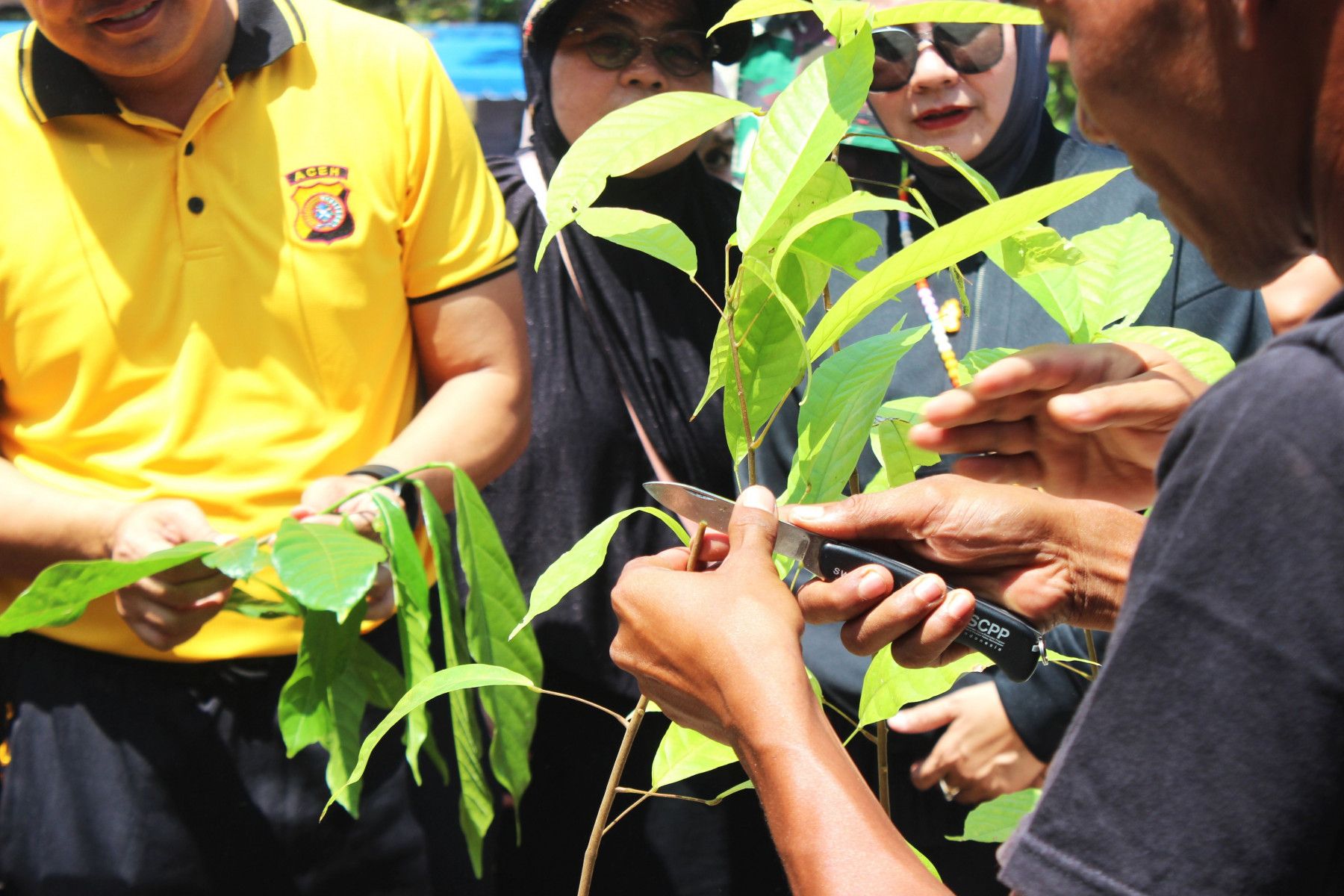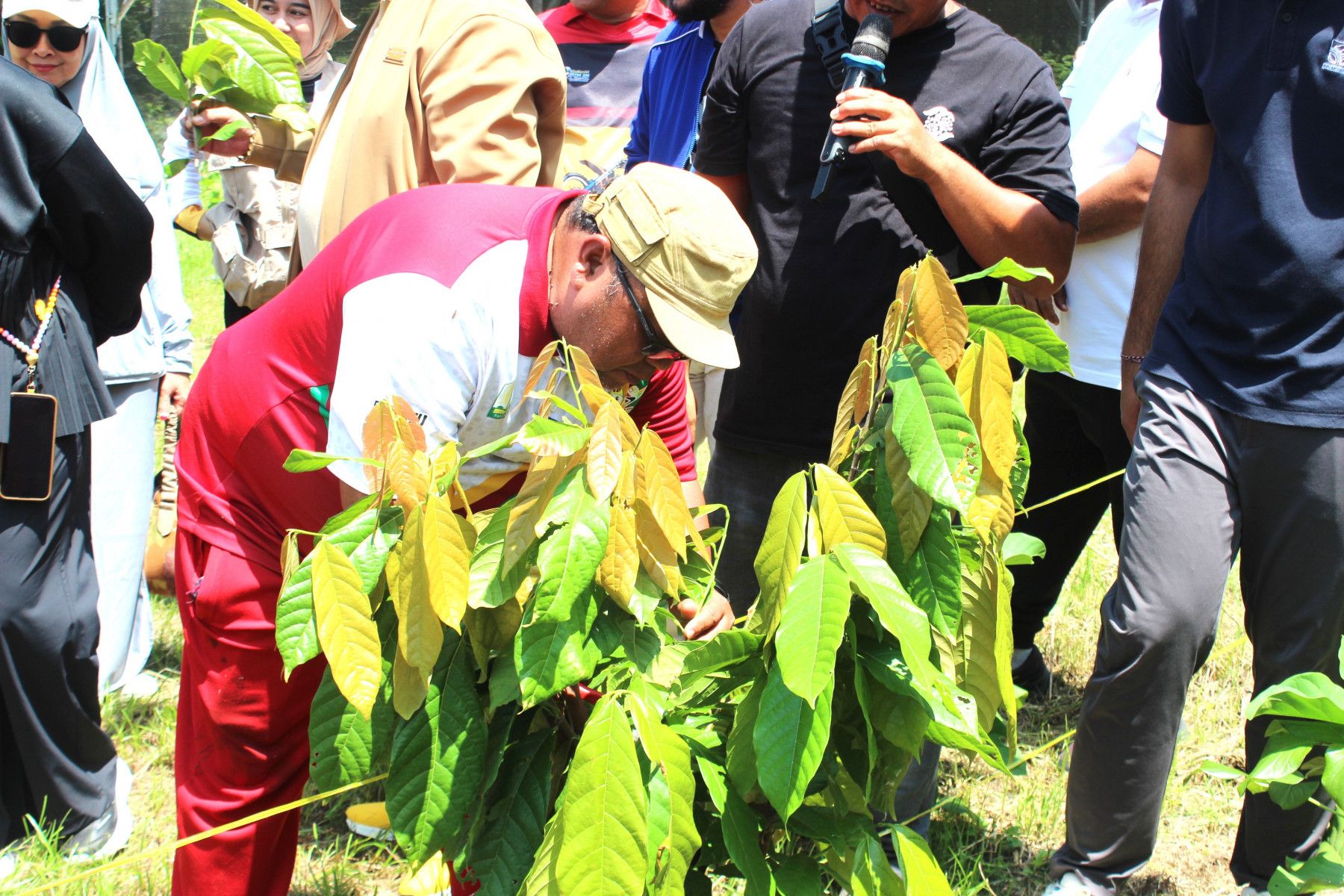
Human nature often draws our attention to the harvest. We admire the sacks of beans and the export figures. In Aceh Tenggara, the key lies in looking beyond the harvest and investing in what makes future harvests better. Prosperity, in most cases, begins years earlier with the quality of the planting material and the systems that support it. Quality seedlings determine productivity. Productivity influences quality. Quality shapes market opportunities, and the latter affects incomes and livelihoods. Needless to say, the journey to world-class cocoa starts with what many consumers never see.
A seedling.
Driving the effort toward quality seedlings is the newly established 1.5-hectare cocoa rootstock garden in Lawe Bekung Village and the 0.5-hectare cocoa budwood garden in Purwodadi Village in July 2026. Supported through a collaboration between Swisscontact Indonesia, PT. Kudeungoe Sugata Indonesia, and the District Government of Aceh Tenggara, these gardens ensure access to high-quality, compatible rootstock and budwood, and are simultaneously positioned as a learning hub for smallholder farmers in the region.
Currently the only one of its kind in Sumatra, it serves as a source of carefully selected genetic planting material that can improve the quality of seedlings produced by local nursery operators. Even if the expected first harvest from the garden still lies ahead, its true value and final goal are to help improve farmers' incomes across the district.
Tracing this journey, Swisscontact Indonesia’s efforts to strengthen sustainable cocoa production in Aceh Tenggara were implemented as early as 2011 and continued through the Sustainable Landscape Programme Indonesia in the Leuser Alas-Singkil River-basin Landscape (SLPI-LASR). Planning for the gardens began in 2025, followed by the signing of a memorandum of understanding between the District Agriculture Office and PT Kudeungoe Sugata Indonesia. Technical assessments helped ensure the compatibility of the cocoa clones, site, and planting design. Land preparation, shade tree establishment, grafting of selected clones, planting, irrigation, weed control, and maintenance followed a carefully managed process. As farmers gained access to training and stronger market linkages, stakeholders began asking a more strategic question about securing gains for the future. The focus shifted towards bridging and building an ecosystem capable of sustaining growth independently.
And this shift was key.
Although quality cocoa begins with quality seedlings, no single organisation can create a globally competitive cocoa sector alone. Among the many requirements are farmers who can apply improved practices, nursery operators who can supply quality planting material, government agencies capable of supporting sector development, businesses that connect farmers to markets, research institutions that contribute expertise, and most importantly, local leadership that can bring these elements together around a shared vision. Every step reflects collaboration. Every partner contributes a different piece of the puzzle, knowing the ambition is to sustain Aceh Tenggara as one of the world's top 50 cocoa producers and Indonesia's top 10.
This requires ownership, and it may be the most important lesson of all.
The success of the cocoa rootstock and budwood gardens will not be measured merely by the number of seedlings it produces. In Aceh Tenggara, the goal is to go beyond producing better cocoa and to build a future where competitiveness and opportunity continue to grow.
Development projects play an important role in catalysing change. They provide technical support and room for innovation, but are never designed to last indefinitely. The long-term future of the district's cocoa sector will depend on local actors that have the capacity and commitment to carry the work forward. Hence, Swisscontact Indonesia, through LASR, supported Sugata as the local catalyst to advance the sector. Together with government agencies, farmer organisations, nursery operators, private-sector actors, researchers, academicians and community leaders, they form the foundation upon which lasting growth and future opportunities are built.
The Sustainable Landscape Program Indonesia in the Leuser Alas-Singkil River-basin Landscape (SLPI-LASR) Phase I is funded by the Swiss State Secretariat for Economic Affairs (SECO) and is implemented by Swisscontact Indonesia in collaboration with Koltiva and PT Kudeungoe Sugata Indonesia.